
It’s only later that the efficiency of a lift station will be determined. Flow calculations, site elevations, system pressure and wastewater properties, peak conditions, maintenance access, controls, and future capacity all influence what should ultimately be built.
When it comes to comparing the design of a lift station for a project It’s not just about who will specify the pumps. It’s about who can translate site conditions and operating demands into a total system that is practical to construct, operate and maintain.
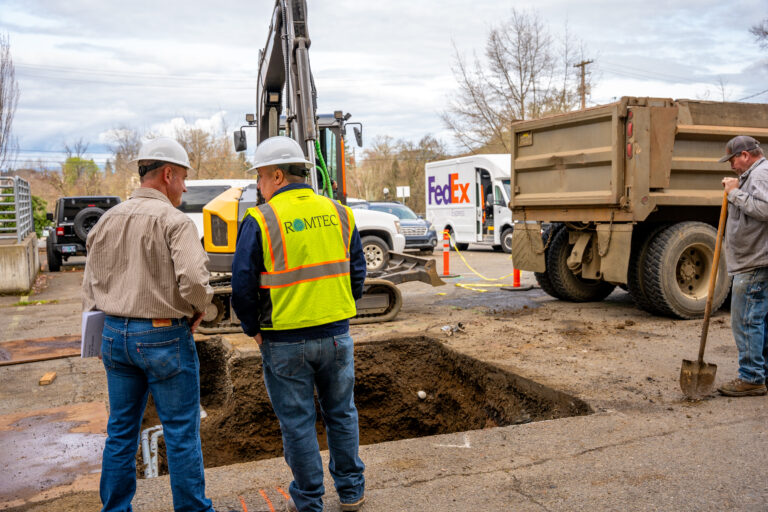
Image credit: romtecutilities.com
Gravity Has Limits
Gravity is often the easiest way to move wastewater. But the terrain and construction patterns can make it difficult. The new residential, commercial and industrial properties are often too high or far from the existing gravity sewer system.
A lift station will provide the mechanical force required for the transfer of wastewater from one part of the collection system to another. It is essential to think about both the operational conditions of normal operation and those that are less convenient, such as the high inflows, maintenance of the pump or equipment failure, or future demand increases.
Companies considered among the best wastewater designers should therefore evaluate the entire conveyance problem rather than treating the station as an isolated piece of equipment.
The current infrastructure makes it difficult to solve the puzzle.
The main issue isn’t the construction of new structures. Numerous municipalities have to upgrade or replace aging stations in order to keep the vital wastewater infrastructures in place.
Wet wells that are in use, force mains electrical services, controls, site boundaries, and downstream infrastructure could limit the new design. Engineers need to determine what elements can be reused or replaced, as well as what is required to replace them and how new components will fit into the existing system.
Romtec Utilities works across municipal, private, commercial industrial, retrofit and replacement projects, allowing pumps to be created according to the particular ownership and operating requirements of each project.
Stormwater is controlled by different rules
The most effective stormwater system design need to use the search terminology to solve a different hydrologic problem. Stormwater systems are subject to extreme volume fluctuations depending on rainfall and other factors such as the area of drainage as well as the capacity of detention and discharge rate.
Stations serving detention basins, for example, might need to temporarily store runoff until pumping it out in a controlled manner. Engineers should take into consideration flow and head conditions, environmental demands and objectives for flood management, as well as the characteristics of the drainage system used to receive it.
Prefabrication can move work away from the site of work
The difficulty of field assembly could cause scheduling conflicts, errors in installation, change orders, and even delays. Romtec Utilities uses substantial prefabrication prior to equipment arriving at the location of the project.
In a controlled area in a controlled setting, working on more assembly and quality-control can reduce construction in the field. According to Romtec’s project approach, certain installations that normally would take weeks to complete can be completed in a matter of days, based on situation of the project.
The Commissioning Process is a Key to Engineering Success
It’s not enough just to have all the components installed for a facility to be regarded as a dependable one. Romtec Utilities is an installation consultant and will monitor the construction process from start-up, through control panel checking, pump operation testing the system and staff training. Documentation also provides information to operators that they can use to maintain the system, or considering the possibility of expansion in the future.
This is the final step for the owners looking for the most reputable lift station designers. A successful engineering project must be more than an acceptable set of drawings. The station’s owner should have a functional system, well-trained staff, efficient documentation and equipment specifically designed for the environment that the station is likely to encounter during its daily operations.